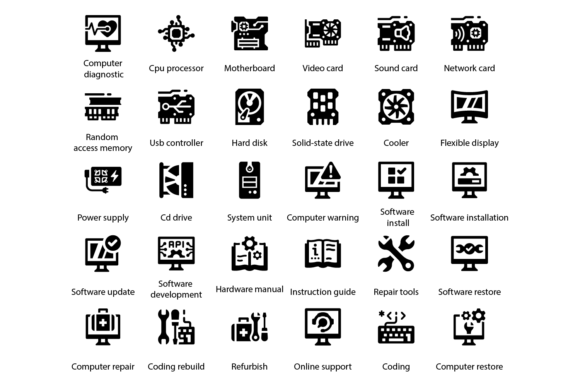
Computer Hardware Icons
Where It Shines (and Where It Asks for Extra Care)
On a structured tote bag with medium-weight canvas? Computer Hardware Icons lands beautifully—especially as a single focal icon near the pocket seam. The satin stitch edges hold definition, and the balanced proportions read clearly from three feet away. As a sweatshirt embroidery? It works best when scaled to 3–4 inches wide—smaller, and fine details like port outlines soften; larger, and the clean lines stay sharp without turning heavy.
For embroidered patches—yes, absolutely. The icons have strong outer contours and minimal internal complexity, which means fewer jump stitches and cleaner backing. I ran a test patch on twill with tear-away stabilizer, and the result looked boutique-ready: precise, confident, and quietly professional.
But here’s where attention matters: on curved surfaces like caps or baby hats, avoid icons with tight interior angles (like the stylized “chip” or “circuit board” variants). They can pucker if hooped too tightly—or worse, distort when the fabric stretches mid-stitch. And on dark fabrics? Double-check thread contrast. Some lighter icons rely on subtle gray gradients that vanish on navy or charcoal unless you adjust fill density or switch to matte thread.
Small Hoops, Stretchy Fabrics, and the “Wash Test” Reality
If you’re stitching for Etsy or craft fairs, remember: your customer will wash that embroidered kitchen towel. Or toss that baby bib in the machine weekly. Computer Hardware Icons holds up well *if* you manage stitch density wisely. Dense fill areas—like the base of a speaker icon—can stiffen thin cotton. I reduced fill density by 10% on those elements and added a light cutaway stabilizer underneath. Result? Soft drape, no puckering, and zero cracking after five cold-machine washes.
On stretchy knits (think toddler t-shirts or lounge sets), skip the smallest icons entirely—or pair them with a lightweight mesh stabilizer fused *before* hooping. Running stitch outlines help, but only if they’re not competing with 12 layers of stretch. And never assume tiny lettering inside an icon (like “USB” or “Wi-Fi”) will survive 2-inch hoop limits. In practice, those labels vanished under thread unless enlarged to at least 0.25 inches tall.
Why This Matters for Your Craft Business
When you sell a handmade product, every design choice signals intention—and trust. Computer Hardware Icons doesn’t scream “tech bro.” It whispers “thoughtful maker.” That tone elevates your brand whether you’re listing on Etsy, stocking a local boutique, or gifting at a baby shower for a software engineer. Customers recognize clarity. They feel the care in spacing, proportion, and restraint.
I used it on a set of linen pillow covers for a small shop launch—and buyers specifically mentioned how “calm” and “uncluttered” the embroidery felt. Not flashy. Not gimmicky. Just right. That kind of quiet confidence builds repeat customers. It also translates cleanly into printable mockups for your listings: no over-rendering needed, no fake shadows or forced gloss. The icons stand on their own.
Practical Notes Every Embroidery Designer Should Keep Handy
- Always test on scrap fabric first—especially with textured weaves like burlap or terry cloth. What reads clean on screen may snag or float on looped surfaces.
- Review thread color contrast on both light and dark backgrounds before finalizing your kit or listing.
- Confirm hoop size compatibility. If your machine maxes out at 4x4”, some multi-icon layouts may need repositioning or simplification.
- Inspect small details at actual stitch scale—not zoomed in on screen. Tiny circles, narrow gaps, or intersecting lines often need manual cleanup in editing software.
- Test black-and-white mockups to ensure recognition without color cues—critical for accessibility and gift appeal.
- Use proper stabilizer: cutaway for knits, tear-away for stable wovens, fusible for lightweight linens.
- Verify licensing before selling finished items or bundling Computer Hardware Icons into digital embroidery files. Commercial use isn’t automatic—even with “graphics” labeled for presentations.
In the end, Computer Hardware Icons earns its place not because it’s trendy—but because it’s *usable*. It respects fabric, honors stitch behavior, and gives makers room to personalize without fighting the design. Whether you’re embroidering a holiday gift for a coder friend, building a cohesive line of tech-themed nursery decor, or launching your next small shop collection—this set doesn’t distract. It supports. And in embroidery, that’s the highest compliment.