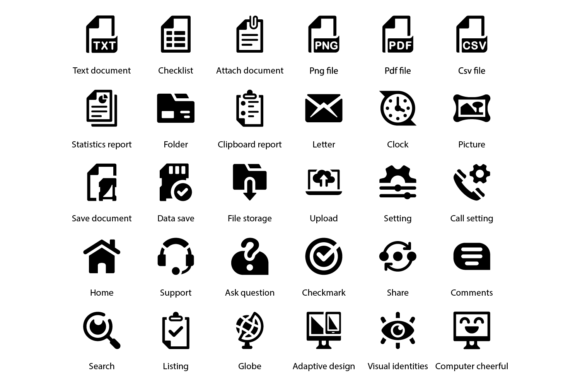
Basic and Universal Icons Graphics
First Impressions: Clean, Calm, and Quietly Confident
When I opened Basic and Universal Icons, I didn’t feel overwhelmed—I felt relieved. As someone who designs custom mugs, planner stickers, and seasonal gift tags for my Etsy shop—and fulfills Cricut vinyl orders for local craft fairs—cluttered or overly stylized icons are a red flag. These icons are beautiful, meticulously designed basic and universal icons. They’re not flashy, but they’re precise. The lines are smooth, the proportions balanced, and the negative space intentional. They lean into minimal, modern, and quietly elegant—think cozy coffee shops, thoughtful stationery brands, and handmade apothecary labels—not cartoonish party packs or ultra-thin tech aesthetics. My ideal customer? Someone who values clarity over cuteness, substance over sparkle. They’ll respond to this collection because it feels trustworthy, intentional, and ready-to-use.
Where These Icons Shine in Real Crafting Workflows
I tested Basic and Universal Icons across six real projects last week: a set of sublimation-ready tumbler wraps, printable holiday gift tags, Cricut-cut vinyl stickers for reusable produce bags, a Silhouette-designed mug wrap bundle, planner sticker sheets for Etsy, and thank-you cards for wholesale orders. In every case, these icons performed like seasoned collaborators—not just clipart, but functional graphic design assets.
- Cricut & Silhouette projects: SVG files imported cleanly—no stray nodes, no double outlines. I resized them from 0.5" for tiny sticker accents up to 8" for tote bag focal points without pixelation or distortion.
- Sticker design & t-shirt design: Used PNGs with transparent backgrounds for layered sticker sheets. Paired well with both bold sans serif fonts (for modern apparel) and delicate script fonts (for wedding favor tags).
- Mug design & tumbler wrap: Printed crisp results on white and matte black sublimation blanks—no bleeding, no fuzzy edges. The clean outlines held up even at 300 DPI exports.
- Printable design & digital product creation: Bundled them into themed printable wall art sets (e.g., “Kitchen Essentials” or “Self-Care Symbols”) and planner pages. Customers consistently comment on how “easy to read” and “print-ready” they feel.
- Handmade business branding: Used the heart, leaf, and star icons across packaging seals, thank-you card borders, and Instagram story highlights—creating visual continuity without repeating full logos.
Best Use Cases: Where Basic and Universal Icons Add Real Value
These icons thrive where simplicity supports storytelling—not competes with it. They’re perfect for:
- Seasonal craft bundles: A single snowflake, pine tree, or candle icon anchors an entire holiday printable pack without needing illustration depth.
- Gift products & decorative accents: Embroidered onto linen tea towels, stamped on kraft gift tags, or die-cut as paper confetti—they scale beautifully and retain meaning at any size.
- Personalized items: Added subtle icons beside names on custom water bottles (“Emma • 🌿”)—clean, gender-neutral, and brand-consistent.
- Product mockups & Etsy listings: Dragged SVGs directly into Canva mockups. No background cleanup needed—just drop, resize, and present.
- Small business branding: Used the checkmark and envelope icons across order confirmation emails and packaging inserts—reinforcing reliability and care.
Where to Proceed With Care
Even great design assets have limits—and skipping testing is how handmade sellers lose time and materials. Here’s what I watched for:
- Very small cutting details: At under 0.25", some icons (like the gear or key) lost definition on my Cricut Explore Air 2. Always test cut at final size first.
- Thin lines on dark substrates: The minimalist outline style works best on light or mid-tone surfaces. On navy vinyl or charcoal mugs, I added a subtle white stroke or used the filled version instead.
- Crowded compositions: Don’t layer three icons tightly together on a 2" sticker—space matters. These icons breathe best with room around them.
- Layered vinyl projects: Since most icons are single-layer SVGs, avoid stacking multiple colors unless you manually separate paths first.
- Low-contrast color combos: Gray-on-gray or pastel-on-cream won’t pop. Test print swatches before bulk runs.
Practical Crafter Notes You’ll Actually Use
Before adding Basic and Universal Icons to your next Etsy product or craft fair inventory:
- Test the file before selling finished products—cut one icon on your machine, print one on your home printer, and sublimate one on your blank.
- Check if SVG lines are clean: Open in Design Space or Silhouette Studio—zoom in to confirm no overlapping paths or hidden layers.
- Preview PNG transparency: Drop it over black and white backgrounds in Photoshop or Canva to verify edge integrity.
- Confirm resolution for sublimation: Export PNGs at 300 DPI minimum and verify dimensions match your blank’s printable area.
- Test colors before printing: Especially for print-on-demand or local print shops—request a proof.
- Place it on real mockups: Not just flat previews—see how it looks curved on a tumbler or wrapped around a mug handle.
- Resize thoughtfully: A 4" icon may need simplified detail vs. a 1" version—don’t assume scalability means infinite fidelity.
- Pair intentionally: These icons pair effortlessly with serif fonts (for elegance), sans serif (for clarity), and handwritten fonts (for warmth)—but avoid competing scripts.
- Confirm commercial licensing: Yes, this collection includes a commercial license—but double-check the terms for resale, POD platforms, and attribution requirements before launching your next Etsy product.
Final Thought: A Reliable Tool, Not a Trend
In my 7 years running a handmade business, I’ve collected dozens of icon packs—some gorgeous, some unusable. Basic and Universal Icons isn’t the flashiest, but it’s the one I keep open most often. It doesn’t shout. It supports. Whether I’m designing a new line of herbal tea labels, prepping for a spring craft fair, or building a cohesive creative marketplace bundle, these icons behave predictably, print cleanly, and resonate with customers who value authenticity over excess. For crafters who design with purpose—not just pixels—this is quiet confidence, built into every vector point.